



A lead is a name. Demand is a part.
When people in industrial sales talk about leads, they usually mean a list: companies that were at a trade fair, downloaded a white paper or reacted on LinkedIn. At AMB in Stuttgart we were out looking for customers ourselves: 87 contacts in one day, 26 of them conversations with decision-makers. In each one we asked how such lists turn into orders. The short answer: rarely directly. A lead says that someone exists. Demand says that there is a part which is made differently today than it could be.
Wherever we asked about the last order won, the story never started with a company but with a specific part or process. At a manufacturer of roller burnishing tools, every sale begins with a part that could be converted, and every quote applies to exactly that part. A provider of acoustic inspection starts with a study for which the customer sends in good and bad parts. A manufacturer of clamping elements develops its new product against the distortion of one specific structural component. In none of these cases would a lead without a part have been progress.

Demand comes from “process today” versus “process new”
So where does demand come from? In all conversations, from the same place: an activity that is done on the shop floor today and could be done differently tomorrow. Roller burnishing replaces grinding or honing because the part stays on one machine. A chuck that the setter changes with a crane several times a week is demand for quick change. A hand refractometer and the canister someone carries through the hall are demand for automatic dosing. Paper in production is demand for costing from actual data instead of target figures.
Demand is manual work that does not have to be manual tomorrow.
So the demand is not in the company but in the process, and that cannot be seen from outside. It can only be asked: what is ground, clamped, inspected, calculated at your plant today, and how?
Disruptions make demand visible
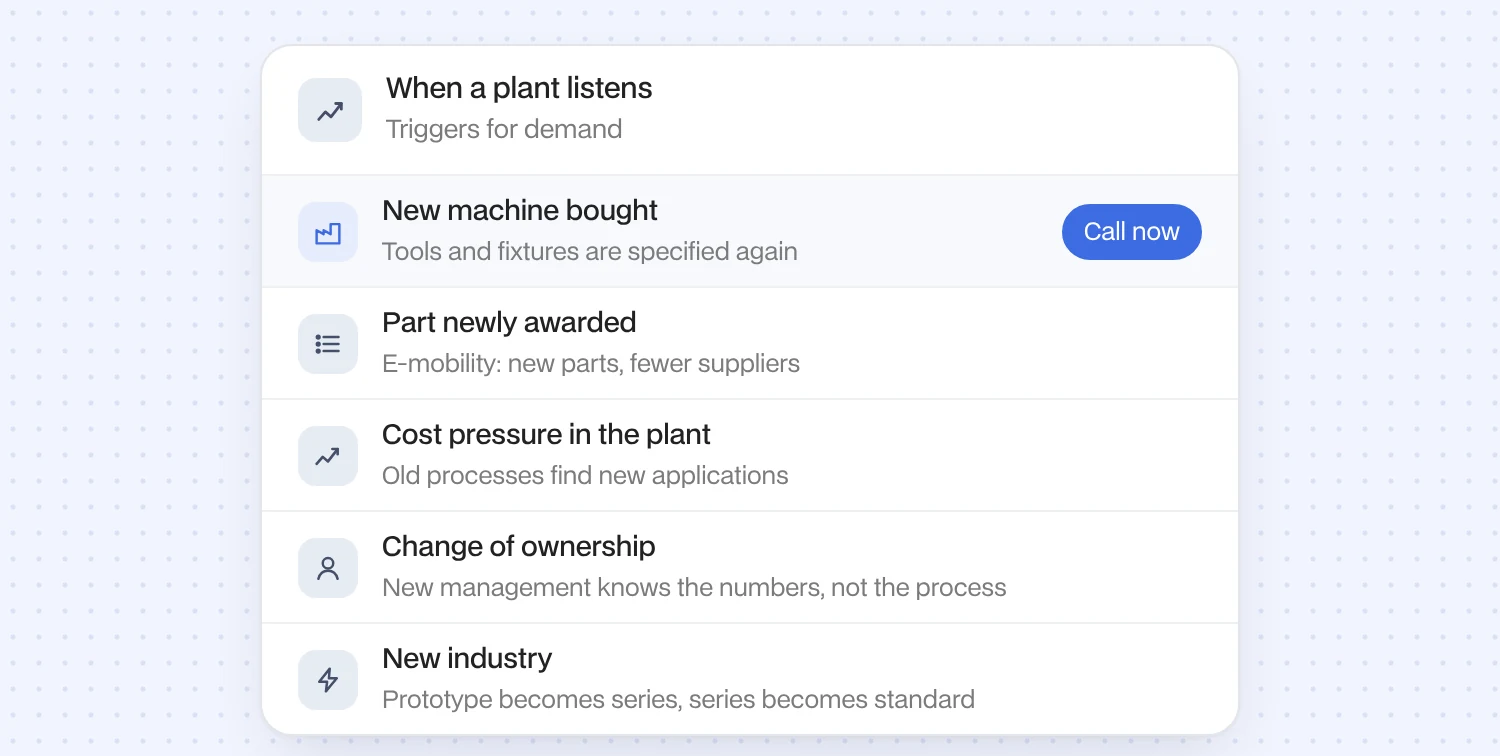
There are moments when plants question their processes, and three of them came up in almost every conversation. E-mobility: a combustion engine has many times the number of parts of an electric drive, and where many suppliers used to be needed, a few will do. So suppliers look for new parts, and old processes find new applications. Cost pressure: everyone is squeezing costs, and relocations to Eastern Europe are clearly felt by field sales. The new machine: whoever has invested re-specifies tools, fixtures and inspection. For some, a fourth trigger came up, the change of ownership: restructurers who buy companies out of insolvency, know the numbers but not the process, and therefore decide faster.
Anyone who knows these triggers does not have to wait for enquiries. They can call exactly where a part is being re-awarded, a machine bought or a plant converted right now.
Inbound depends on the economy and is hardly qualified
Many of the companies we spoke to live mainly on enquiries. One described his business as almost entirely inbound-driven: the customer calls, the salesperson asks for the parameters. That works as long as the enquiries keep coming. Another simply called the share of enquiries dependent on the economy. When fewer come in, you have to look for customers, and your existing customers have to find new ways internally.
Whoever waits for enquiries only talks to those who already know them.
The second problem: hardly anyone has a fixed routine for qualifying an enquiry. Whether it is complete depends on the knowledge of the person taking it; at one clamping element manufacturer, the experience of the partner's field sales decides whether the enquiry is usable. Inbound delivers names with a wish. Whether there is a part behind it is only clarified in the conversation.
Lists and agents do not replace the follow-up
Only a few use software to identify target customers, and those who do named the same limit. The most interesting case: a software provider who wrote his own agent. It reads exhibitor lists and trade press, checks the photos on company websites for the machine type and delivers hundreds of qualified names. And then? Then, by his own assessment, the real work begins: the technical follow-up. His young team shies away from the phone, even though calling works well for him.
That is the core of the problem. Identification is solved; there are enough tools for it. The bottleneck sits behind it: someone has to call, work their way through the switchboard to production and talk to the person who is responsible for the part. Only that conversation turns a name into demand.
Cold calling fails on the threshold, not on rejection
Cold calling is practice. Whoever pauses loses their nerve first, not their customers.
Hardly anyone runs cold acquisition as a fixed routine. One who does, a field sales rep with at least one cold visit a day, described it like a craft: the first attempts end with a no, a colleague collects rejection after rejection, and whoever pauses too long no longer dares. At almost all the others, the amount of cold acquisition depended on how much was coming in at the time. When the order book was good, nobody called. When it was bad, the practice was missing.
The customer's demand does not disappear during that time. It is simply found by nobody.
The first sale is a study, a test, a training
How does recognised demand become an order? Strikingly many first sell something small and paid before they write a quote. The inspection system provider: first a study with parts sent in, then the sale. The software provider: first a training, then the demo, otherwise none at all. The clamping element manufacturer: test phases at the customer until the product goes into series. The costing provider: test customers who have already paid because the first evaluations showed something immediately.
All of them ask the customer for an early commitment, and all of them gain from it: the customer invests before buying and knows what they are getting before spending a euro. And it was exactly these providers who described their sales cycles as the shortest.
The right moment
After the trade fair, a tool manufacturer told us, the calls come from those who have just bought a new machine and now need the tools for it. An inspection system provider knows after installing the first system what he can sell next. The clamping element manufacturer is there when a need arises at the partner. New machine, new part, new industry: those are the moments when a plant listens. Whoever knows them does not call at random.

Conclusion: four questions instead of a list
Real demand does not come from leads, because a lead knows nothing about the process. It comes at the moment someone answers four questions on the phone: which part? How is it made today? Who is responsible for it? And what has just changed? In 26 decision-maker conversations on one day at the fair, we did not find a single order that had come about any other way. Whoever has these four answers does not need a long list. They need a meeting at the machine.
That is exactly how we work at LeadLane: we pick out the plants where a process runs that your technology can replace, call there and only hand over once the part, the contact and the meeting are fixed. The knowledge that turns a name into demand is in the conversation.