



One day at the fair, 87 contacts, 26 decision-maker conversations
We went to AMB in Stuttgart to win new customers for LeadLane ourselves. One day, 87 contacts at the booth and in the halls, 26 of them conversations with decision-makers: managing directors, heads of sales and field sales reps of manufacturers of clamping and tooling technology, inspection and measurement systems, automation and robot software, costing and planning software. Our question was the same in every conversation: how does your technology reach new customers today, and where does it get stuck?
The answers differed, the pattern was the same. Hardly anyone fails because of the product. Pitches fail because of who they reach, what they open with, and what they ask of the other side before that person even knows whether they have a topic. These are our learnings.
The pitch lands with the wrong person
Almost everyone described the first contact with a new customer the same way: the brochure goes to the switchboard, the switchboard passes it to purchasing, and purchasing waves it off because it sees no need. Production would have one. If the request later does come from production, the tool counts as too expensive in purchasing.
The product is needed where the part is made: at the machine.
Purchasing compares prices for things someone has already ordered. Whether a part could be made differently is not its decision, and it does not recognise it either. A pitch that lands in purchasing is therefore not rejected but filed. Anyone selling technology that needs explaining has to arrive where the part is made: with the head of production, in process planning, with the setter. The exhibitors who have solved this look for their contacts directly at the shop floor, past the gatekeeper if necessary.

No part, no conversation
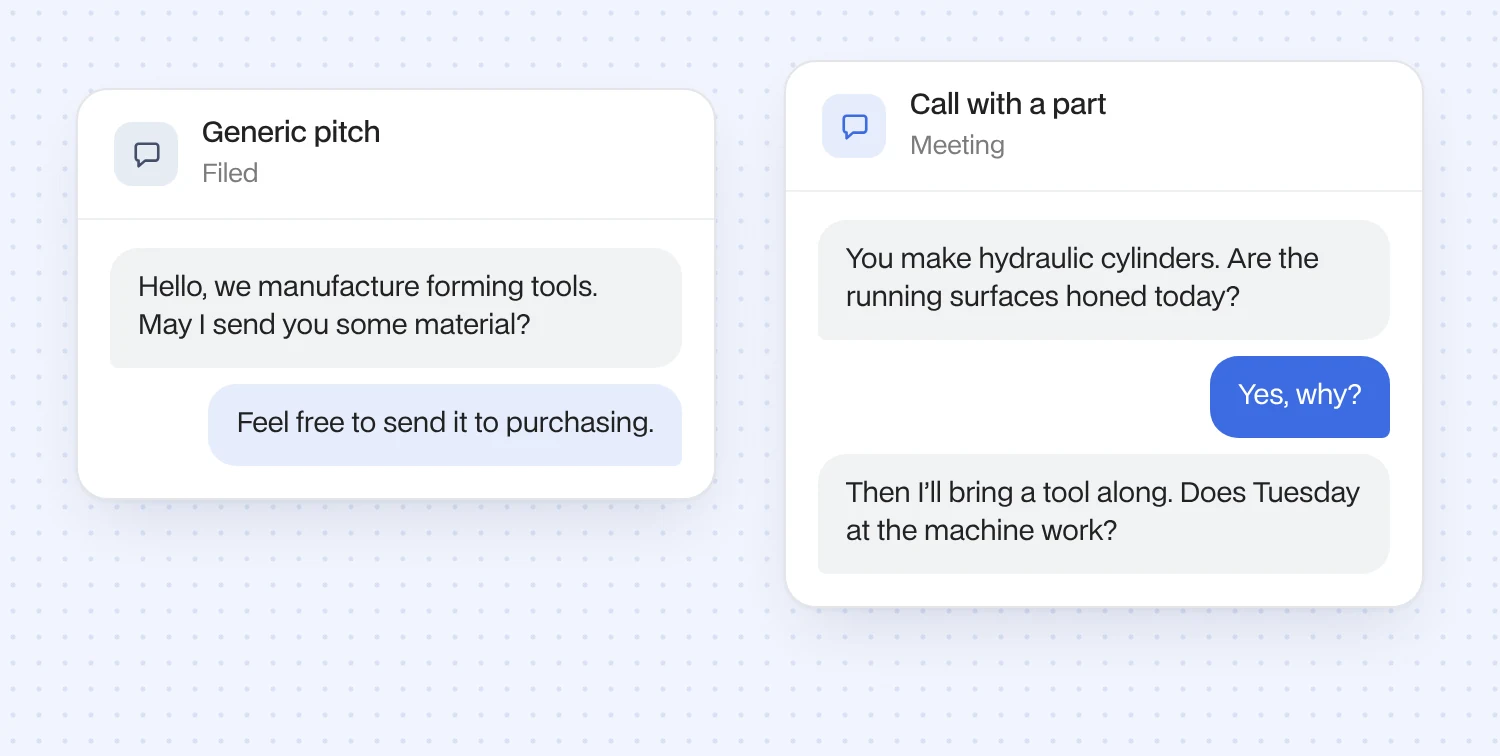
The second reason lies in the opening. For almost all of them, the price depends on the part: catalogue prices are not enough, every quote is part-specific, and at several manufacturers the salesperson is also the design engineer and asks for the parameters over the phone. For these buyers, a pitch without a part has nothing to attach to. They cannot evaluate it, because the reference is missing.
The sentence that starts a sale at these companies is not about a new technology but about a part that could be converted. And the customer phrases his demand as a brief: here is my topic, bring me a solution. Both require that someone knows the part before the presentation begins.
The demonstration beats any brochure
The proof happens at the object, not on the brochure.
Again and again, the demonstration at the object came up as the moment the order is decided. When a customer says it is all theory, the experienced rep does not reach for the next slide but for the tool in the boot of his car, and takes it to the machine. A clamping technology salesman told us about the setter who changes the chuck with a crane several times a week and asks for a quick-change system. What sold was the counter-question: in which situation does the chuck actually have to come off? A software provider has parts sent in, films a video of them, and only those who are happy with the video come to visit.
The common denominator: a pitch without a part, a machine or a workpiece asks the other side to believe something they could verify.
The channel is a question of how much explaining is needed
Asked whether phone, email or LinkedIn work, hardly anyone named one of these channels as a reliable first contact, and those who did sell a product that needs no explaining. Everyone else described the same picture: customers feel bombarded and are relieved when someone actually shows up on site. An inspection system provider put it precisely: cold outreach works well for him, but paid ads only for the one product that needs no explanation.
The difference is not the channel but the message. A generic enquiry is ignored in every channel. An enquiry that names the part and today's process gets answered in every channel, including the phone. The channel question is really the question of whether the person calling understands the application.
Non-committal demos are the most expensive part of sales
Only a few have a firm rule against non-committal demonstrations. The founder of an automation software company abolished free demos after one prospect had demanded demonstration after demonstration and ended up buying from nobody. His calculation: the demos of bad customers are paid for with the money of good ones. Today the demo only follows a training the prospect completes beforehand. For him, one of the two steps that got his sales moving.
An inspection system provider asks for a study with parts sent in first, or a purchase with acceptance criteria. A clamping element manufacturer runs its new product in test projects instead of presenting it broadly. Most drive out to demonstrate as soon as someone shows interest, and named exactly that as their biggest time sink. The few with a rule have understood the same thing: a pitch that asks for nothing is not taken seriously. A small commitment before the demo separates the curious from those who have a part.
Whoever sells has to understand the application
Application knowledge comes from practice, not from a training week.
What makes a good salesperson in this market? The answer was the same in almost every conversation: a technician with an understanding of requirements. The onboarding times mentioned ranged from half a year to two years, and the customer does not want an apprentice on the phone. At one clamping element manufacturer, the quality of an enquiry depends on whether the partner's field sales has known the product for many years or for a few weeks.
That is why many pitches fail before they begin: they are delivered by people who know the product but not the other side's part. The buyer hears it immediately. He has no time to train anyone.
What this means for your pitch
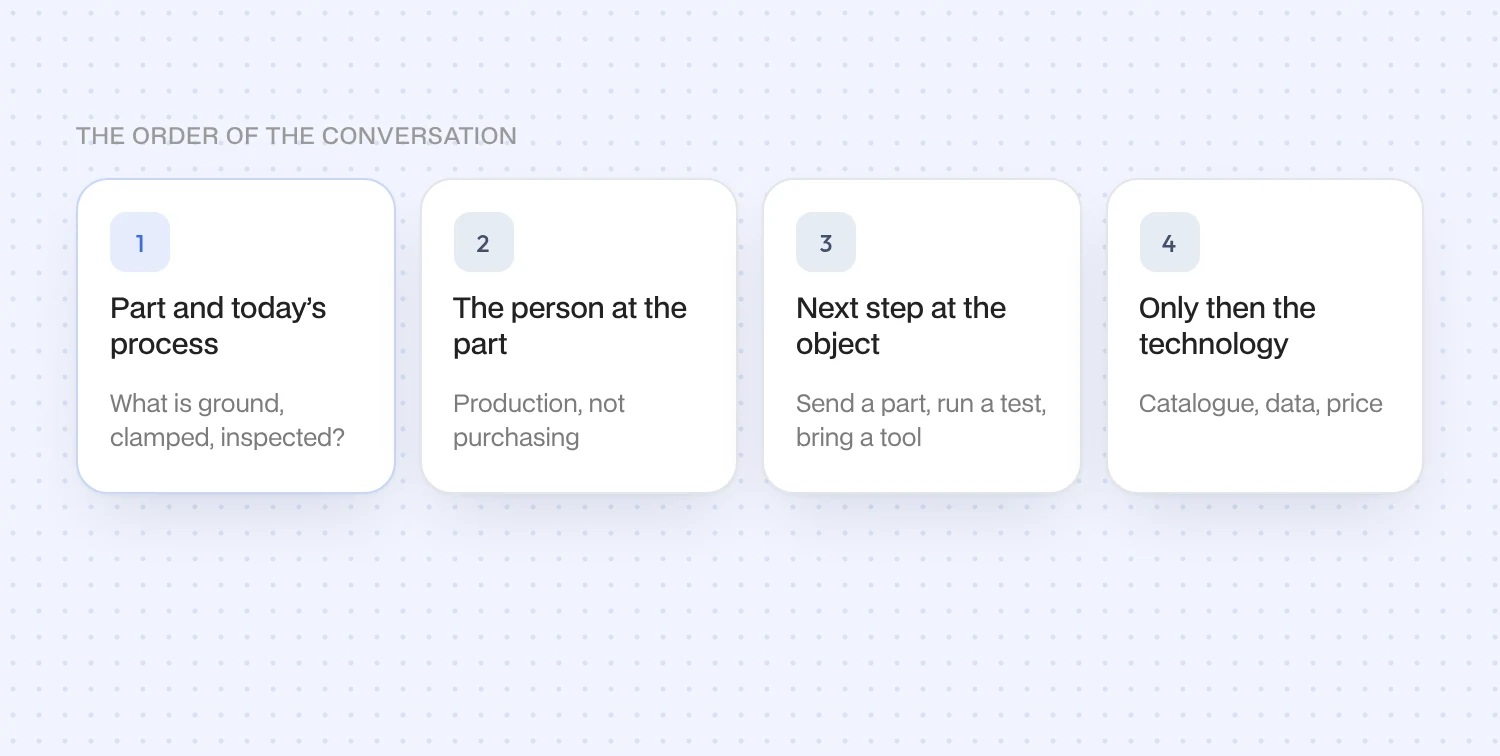
A simple order can be derived from the conversations. First the part and the process that runs today: what is ground, honed, clamped, inspected, costed? Then the person responsible for the part, not the department that pays for it. Then a small, concrete next step at the object: send a part in, put a tool on the machine, run a test with acceptance criteria. And only then the technology.
A side note on language: a provider of costing software has removed the word SaaS from its vocabulary because its customers could not relate to it. Another has learned that software-as-a-service slows down the procurement process in manufacturing. What the buyer cannot place, he classifies as risk. Describe what happens to the part, not which category your product plays in.
Conclusion
Industrial buyers do not ignore technology. They ignore pitches that land in purchasing, start without a part, prove on paper instead of at the machine, and ask for nothing. In 26 decision-maker conversations on a single day at the fair, this repeated itself at every turn. Whoever reverses the order no longer pitches but has conversations about a specific part. That is where these buyers make their decision.
It is also why we at LeadLane start every conversation with the part and only hand over once the application fits, the decision-maker has been reached and a project is planned. The knowledge that carries a pitch is not in the deck. It is in the conversation.